Treating postpartum depression benefits babies
© 2022 Gwen Dewar, Ph.D., all rights reserved
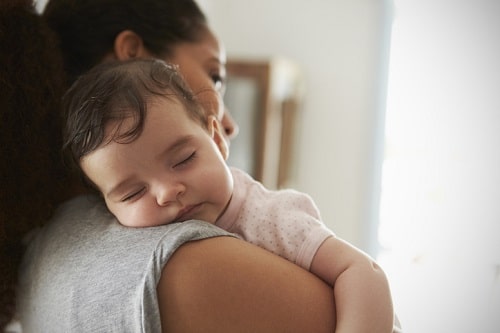
Treating postpartum depression is crucial for the well-being of mothers, simply studies suggest that it benefits babies, too — improving an infant's ability to regulate emotions.
Imagine you're a baby in a researcher's laboratory. You are sitting on your mother'southward lap, facing forward, gazing at a friendly stranger.
Yous are wearing a little EEG cap on your head — a device fitted with electrodes for detecting encephalon activity. You also having your center rate monitored, though you don't realize information technology.
The main matter occupying your attention is the friendly stranger. She's holding an interesting toy in front of your face.
How practise you react? What sorts of physiological changes practice yous feel?
It depends, of course, on a lot of things, including your personal temperament. But it besides depends on whether or non your mother is clinically depressed.
When women endure from postpartum low, or PPD, their infants tend to be less soothable and less cuddly. Their babies bear witness less pleasure or enjoyment during laid-back, depression central activities. Their babies pay less attention to things, too.
And in a situation similar this — coming together a friendly stranger — these babies are more likely to experience physiological reactions that are linked with stress, negative emotions, and behavior issues.
For example, accept brain activity. If you're a baby meeting a friendly stranger, a good for you response is to bear witness heightened electrical activeness on left side of the frontal regions of the brain. This pattern of disproportion (left over right) is linked with the evolution of ameliorate emotion regulation.
But when babies are growing up with depressed mothers, they may show the opposite blueprint — greater electrical action on the right side of the frontal cortex. Information technology'due south a pattern associated with negative emotions and social withdrawal.
What about the beating of your heart? When y'all meet someone new, the ideal response is to experience lots of variability in eye rate. It's an indication that you can switch gears chop-chop, that yous're flexible. Not overly stressed-out.
But unfortunately, infants with depressed mothers tend to experience lower levels of middle variability. And that's a sign that something isn't right — that the encephalon is having more trouble coping with stress.
In that location is indication of other problem, likewise. Links between maternal depression and developmental bug.
Babies who have depressed mothers are at higher risk for poor cognitive outcomes.
They tend to develop language abilities at a slower pace.
They are more likely to develop behavior problems and mood disorders (Slomian et al 2019).
Why is maternal depression linked with worse child outcomes?
To some degree, information technology's a reflection of shared genes. Genetic factors tin can put a woman at higher risk for emotional difficulties — including postpartum low. If her kid inherits these genetic factors, that kid is more likely to develop problems with emotional regulation.
But in that location'due south as well a large environmental component.
When parents are depressed, they don't relate to their children in the aforementioned way.
They may show less warmth, closeness, or sensitivity, and they are less likely engage their kids in responsive, contingent, turn-taking conversations (Bind et al 2021).
In addition, studies advise that depressed parents are less probable to read to their children, or to play games with them. They are less probable to share smiles and positive emotions (Slomian et al 2019).
And then low makes it harder for parents to "tune in" to their children. It can set the parent-child relationship on the wrong track, and prevent parents from providing kids with crucial learning experiences. Piffling wonder if children struggle.
Disturbing? Of course. But this isn't a tale of doom and gloom. With support, parents can recover from depression. And when parents get handling, children do good.
Evidence that treating postpartum low helps infants develop meliorate emotion regulation
How can we exam the thought that treating postpartum low is benign to babies?
Controlled, randomized experiments are unremarkably the best manner to respond such questions. Merely here we have a big ethical problem. Nobody wants to take a bunch of depressed mothers, and randomly assign families to dissimilar experimental conditions.
Provide some mothers with psychotherapy, and ignore the rest. Then encounter how their babies turn out.
Not very humane.
Then John Krzeczkowski and his colleagues — researchers at McMaster University — take tried some other approach.
Showtime, you recruit mothers who have been diagnosed with major depressive disorder in the 12 months since giving nascence.
Then yous match these mothers with a control grouping — women who aren't depressed, but who have babies of the same age and sexual activity, and who come from similar socioeconomic backgrounds.
The next pace is to examination all the babies. Find out what they are similar at baseline — earlier yous help the depressed mothers.
After these preliminary tests, y'all provide the struggling mothers with therapy. Then you re-test the babies, and see if the children of depressed mothers have improved. Are they reacting the same as before? Or are they beginning to expect more similar the healthy children of non-depressed mothers?
Krzeczkowski and his team did this in two separate studies, and in both cases, they saw babies change over time.
In one report, researchers tested babies' reactions to that "friendly-stranger-with-a-toy" situation.
The babies with depressed mothers showed show of poorer emotional regulation on every mensurate — lower scores on behaviors similar soothability; greater electric activity on the right side of the frontal cortex; and reduced heart rate variability.
But that was before mothers completed 9 weeks of cerebral behavioral therapy, a type of "talk" therapy that helps you identify maladaptive thinking and habits, then supervene upon these with effective, problem-solving strategies.
After this handling, the babies improved — so much so that their responses were indistinguishable from those of infants in the control grouping. They reacted and behaved like the babies of mothers who had never experienced postpartum depression (Krzeczkowski et al 2020).
That's good news, and it was echoed in a second report, a study where the researchers tested how babies responded to a potentially disturbing sight — their ain mothers staring at them with a wooden, emotionless expression.
In that location was a notable divergence between groups at the beginning of the study. Babies with depressed mothers were more probable to respond to the "still face" by acting sad, or attempting to disengage.
Only subsequently their mothers received cerebral behavioral therapy, these babies became less withdrawn, somewhen reaching a point where their responses to the "still face" were duplicate from those of babies whose mothers had never struggled with postpartum low (Ntow et al 2021).
Does this mean that everything will become well if mothers become treatment for postpartum depression?
Handling is really of import, peculiarly given how long-lasting postpartum depression can exist. In a recent study of American mothers, 25% were still experiencing depression symptoms at three years postpartum (Putnick et al 2020). This isn't something you want to "wait out."
But it's besides crucial to realize that treating postpartum depression is only part of the solution.
As noted in a higher place, depression can steer the parent-child relationship off-course. It's non unusual for families to get caught up in a vicious circumvolve — reacting to each other in ways that keep triggering more than negativity. Recovering from depression is helpful, but it won't necessarily modify all of these behaviors. Non if they've become habits.
Then sometimes treating the low isn't enough. Parents may need help getting the parent-child relationship back on track. This includes learning to read their babies' behavioral cues, and coming up with the all-time responses to challenging behaviors — responses that will enhance the parent-child bond, and back up the evolution of emotional and social skills.
What's a good therapy for improving parent-child interactions?
Researchers take tested a number of approaches, including these:
- Video feedback. The parent and kid are video-recorded during everyday activities; a trained therapist shares highlights with the parent, calling attention to moments where the parent was peculiarly attuned to the kid'southward signals.
- Parent-infant psychotherapy. A therapist meets with both parent and child, and helps the parent discover an individualized arroyo to improving the child'southward behavior.
- Parent-child interaction therapy (PCIT). An approach for coping with behavior issues in children ages ii-vii, PCIT provides parents with "live" coaching.
- Group-based interventions that combine straight instruction (on how to better empathise your child'south cues) with real-time practice.
There are studies supporting the apply of these approaches, but unfortunately much of the research lacks rigorous controls. So experts often charge per unit the bear witness as mixed or inconclusive.
For instance, a recent meta-analysis of published studies reports "…moderate‐certainty bear witness that video feedback may better sensitivity in parents of children who are at adventure for poor attachment outcomes due to a range of difficulties." But it also finds "no prove of the effectiveness of video feedback on child behaviour" (O'Hara et al 2019).
Similarly, another meta-analysis has concluded that while parent-child psychotherapy "is a promising model in terms of improving infant attachment security in high-hazard families, there were no significant differences compared with no treatment or treatment-as-usual for other parent-based or relationship-based outcomes" (Barlow et al 2015).
Only I think it'south a good bet that whatsoever arroyo is worthwhile if it helps you (one) foster positive emotions and defuse stress; (2) understand and tune into your babe; and (3) feel respected, supported, and capable.
Forth these lines, a recent written report published in Australia reports positive results for a group-based parenting programme for mothers recovering from depression.
All mothers in the report received cognitive behavioral therapy for postpartum depression, but only half of them were randomly assigned to receive an boosted treatment — iv special sessions that focused on observing and agreement baby cues, and learning how to reply to these cues in ways that promote skilful feelings and a healthy zipper bail (Holt et al 2021; Milgrom and Holt 2014).
Compared to mother-infant pairs in the command group, female parent-infant pairs in the treatment grouping were less likely — six months after — to experience impaired bonding (Holt et al 2021).
More information near postpartum depression, handling, and improving parent-child interactions
What are the signs and symptoms of postpartum low? How to doctors distinguish between postpartum low and less severe mood disorders? Read more about information technology in the Parenting Science commodity, "Postpartum depression symptoms: When is information technology more than the "baby blues?"
And for more data nearly keeping the parent-child human relationship on track, check out these Parenting Science offerings:
- "Stress in babies: How to go on babies calm, happy, and emotionally healthy"
- "The Foreign Situation exam: Is your child deeply attached?"
- "Can babies sense stress in others?"
- "Mind-minded parenting: Does insightful talk about the heed help children bail and learn?"
- "Positive parenting tips: Getting better results with humor, empathy, and diplomacy"
- "Parenting stress: 12 evidence-based tips for making life better"
References: Treating postpartum low
Barlow J, Bennett C, Midgley Northward, Larkin SK, Wei Y. 2015. Parent-infant psychotherapy for improving parental and infant mental health. Cochrane Database Syst Rev. 1:CD010534.
Demark RH, Biaggi A, Bairead A, Du Preez A, Hazelgrove K, Waites F, Conroy S, Dazzan P, Osborne South, Pawlby Due south, Sethna 5, Pariante CM. 2021. Mother-infant interaction in women with depression in pregnancy and in women with a history of low: the Psychiatry Research and Motherhood – Low (PRAM-D) study. BJPsych Open. 7(3):e100.
Holt C, Gentilleau C, Gemmill AW, Milgrom J. 2021. Improving the female parent-infant relationship following postnatal depression: a randomised controlled trial of a brief intervention (HUGS). Arch Womens Ment Health. 2022 Mar xix. doi: 10.1007/s00737-021-01116-five. Online ahead of print.
Krzeczkowski JE, Schmidt LA, Van Lieshout RJ. 2020. Changes in infant emotion regulation post-obit maternal cognitive behavioral therapy for postpartum depression. Depress Anxiety. 2022 Apr;38(4):412-421.
McLearn KT, Minkovitz CS, Strobino DM, Marks Due east, Hou Westward. 2006. Maternal depressive symptoms at 2 to 4 months post partum and early parenting practices. Arch Pediatr Adolesc Med. 160(3):279-84
Milgrom J and Holt C. 2014. Early intervention to protect the mother-infant relationship post-obit postnatal depression: report protocol for a randomised controlled trial. Trials. xv:385.
Ntow KO, Krzeczkowski JE, Amani B, Savoy CD, Schmidt LA, Van Lieshout RJ. 2021. Maternal and Baby Functioning on the Face-to-Face up Still-Face up Job following Maternal Cognitive Behavioral Therapy for Postpartum Low. J Affect Disord. 2022 January 1;278:583-591. doi: 10.1016/j.jad.2020.09.101. Epub 2022 Sep 29. PMID: 33032029
O'Hara 50, Smith ER, Barlow J, Livingstone N, Herath NI, Wei Y, Spreckelsen TF, and Macdonald G. 2019. Video feedback for parental sensitivity and attachment security in children under five years. Cochrane Database Syst Rev. 11(eleven):CD012348.
Putnick DL, Sundaram R, Bell EM, Ghassabian A, Goldstein RB, Robinson SL, Vafai Y, Gilman SE, Yeung Eastward. 2020. Trajectories of Maternal Postpartum Depressive Symptoms. Pediatrics. 146(5):e20200857. doi: 10.1542/peds.2020-0857.
Rogers A, Obst S, Teague SJ, Rossen L, Spry EA, Macdonald JA, Sunderland M, Olsson CA, Youssef G, Hutchinson D. 2020. Association Between Maternal Perinatal Depression and Feet and Child and Adolescent Evolution: A Meta-analysis. JAMA Pediatr. 174(xi):1082-1092.
Slomian J, Honvo K, Emonts P, Reginster JY, Bruyère O. 2019. Consequences of maternal postpartum depression: A systematic review of maternal and baby outcomes. Womens Health (Lond). 15:1745506519844044.
Content of "Treating postpartum depression benefits babies" concluding modifed 7/26/21
image by monkeybusinessimages / istock
Source: https://parentingscience.com/treating-postpartum-depression/

Posting Komentar untuk "Treating postpartum depression benefits babies"